
Sub-Total: $0.00 CAD
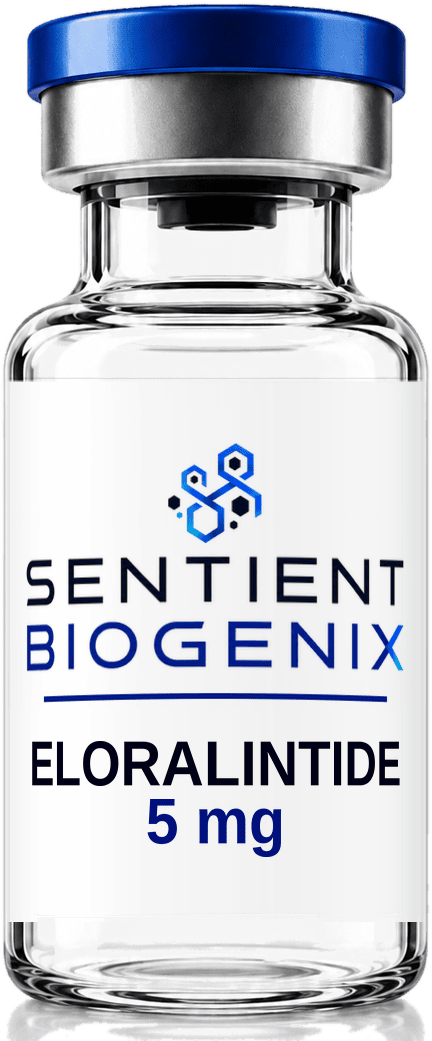
Eloralintide 5mg
Price on release
Selective amylin receptor agonist (AMY1R). Once-weekly subcutaneous. Supplied as a lyophilised powder in a 3 mL vial.
Arriving within the month — $139.00 CAD on release. Leave your email below and we will tell you the day it lands.
Not in yet
This one has not arrived. Leave your email and we will write to you once — the day it lands, with the certificate. No list, no marketing, and you can ignore it with no consequence.
Description
What it is
Eloralintide (development code LY3841136) is a long-acting selective amylin receptor agonist. Amylin is a pancreatic hormone co-secreted with insulin that acts as a satiation signal — it ends a meal, slows gastric emptying and suppresses post-meal glucagon.
What distinguishes it from cagrilintide, the other amylin analogue on this shelf, is selectivity. Cagrilintide is non-selective, activating all three amylin receptor subtypes and the bare calcitonin receptor. Eloralintide preferentially activates AMY1R — roughly twelvefold over the calcitonin receptor and elevenfold over AMY3R in human receptor assays.
What has actually been studied
According to PubMed, a 48-week phase 2 trial published in The Lancet randomised 263 adults across 46 US centres to once-weekly placebo or eloralintide at 1, 3, 6 or 9 mg, or to two escalation schemes. Mean body-weight change at 48 weeks was −9% (1 mg), −12% (3 mg), −18% (6 mg) and −20% (9 mg), against −0.4% on placebo. Every arm beat placebo. (DOI)
The most common adverse events were nausea and fatigue, and both were strongly dose-dependent: nausea ran 11% at 1 mg and 13% at 3 mg against 14% on placebo, but reached 64% at 6 mg. Fatigue ran 0% at 1 mg and 43% at 9 mg against 12% on placebo. The low doses are where the tolerability is, and 1 mg still delivered −9%.
A 12-week phase 1 study in 100 participants reported infrequent gastrointestinal events — diarrhoea 10%, nausea 8%, vomiting 4% — with weight change of 2.6% to 11.3%. (DOI)
What is not known
- Eloralintide is not approved anywhere. It is investigational. A phase 3 monotherapy programme began enrolling at the end of 2025 and has produced no published results.
- No published trial combines eloralintide with a GLP-1 receptor agonist. The manufacturer has said it is evaluating that combination; that is an intention, not a result.
- No body-composition data has been published — nothing on what it does to lean mass.
- There is no approved lyophilised presentation of any amylin analogue, so every reconstitution protocol in circulation, including ours, is an extrapolation.
Handling
Supplied as a dry lyophilised powder in a 3 mL vial. There is no oral form. Our house reconstitution is 1 mL of bacteriostatic water, giving 5 mg/mL — so one unit on a U-100 insulin syringe is 50 mcg, the same per-unit arithmetic as our cagrilintide.
Unmixed, store in the fridge or freezer; both are fine, and the freezer is better if it will sit. Once mixed, refrigerate at 2–8 °C and never freeze. We recommend using a reconstituted vial within about 28 days — that is a handling convention resting on the preservative in bacteriostatic water and on how many times a stopper has been punctured, not a measurement of when the peptide stops working.
Every batch is third-party tested and the certificate is published at sentientbiogenix.com/coa, searchable by the lot number printed on the vial.
Supplied for laboratory research use only. Not for human or veterinary use, and not for diagnostic or therapeutic purposes.
What others are saying
There are no contributions yet.